


It’s 3 am. The room is dark, the house is quiet, but you’re wide awake. Maybe you kicked off the covers ten minutes ago, heart pounding, skin damp. Maybe your mind just switched on out of nowhere, running through tomorrow’s to-do list like it’s the middle of the afternoon. Maybe you’ve been watching the clock since 2. You’re tired in your bones, but sleep won’t come back for you.
This is menopause insomnia or perimenopause insomnia, and it’s one of the most common things I hear from women in my practice. Not as a footnote to their appointment. As the thing that’s quietly unraveling everything else. Your patience. Your mood. Your ability to think clearly. Your sense of self.
Sleep is not a luxury. It’s the foundation of every other aspect of your health: your mood, your metabolism, your memory, your heart, your immune system. When sleep goes, everything else starts to wobble. So let’s talk about what’s actually happening in your body, and what you can do about it.
Why Menopause Causes Insomnia: It’s Hormonal, Not in Your Head
Before we get to solutions, you need to understand the why, because when you understand what’s happening inside your body, you stop blaming yourself.
During perimenopause, your ovaries begin producing less estrogen and progesterone. This transition can start as early as your late 30s, often showing up as changes in your menstrual cycle before you notice any other symptoms. These two hormones aren’t just reproductive; they are deeply woven into your sleep architecture.
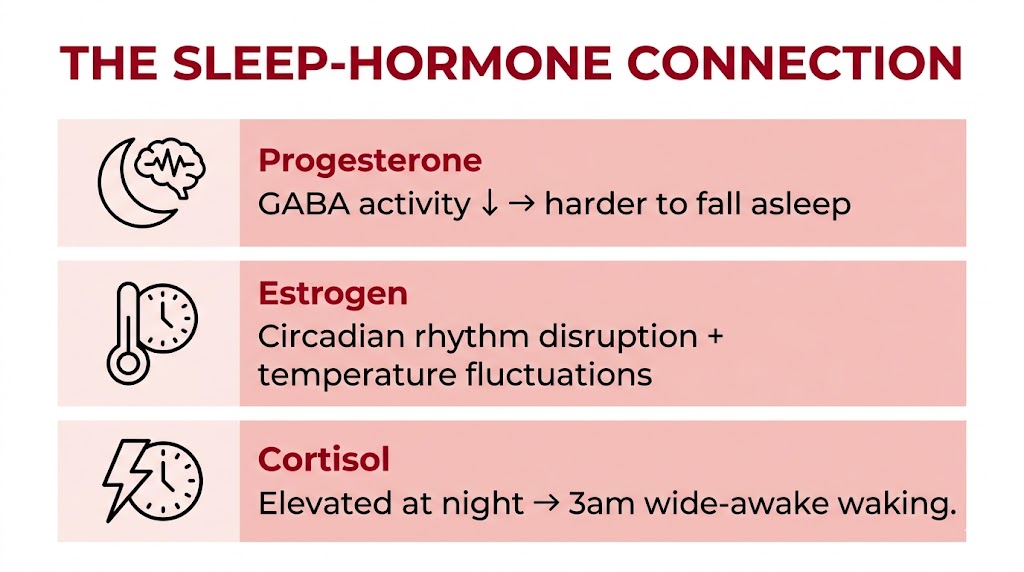
Progesterone has natural sedative properties. It promotes GABA activity in the brain. GABA is the neurotransmitter that calms your nervous system and helps you fall and stay asleep. As progesterone declines, that natural calming effect weakens. Falling asleep gets harder. Staying asleep gets even harder.
Estrogen supports serotonin production, regulates your body temperature, and helps govern your circadian rhythm (your internal 24-hour sleep-wake clock). When estrogen drops, your body’s thermostat becomes erratic. The result? Hot flashes and night sweats that yank you out of deep sleep, often multiple times a night.
And then there’s cortisol — your stress hormone — which tends to run elevated during the menopause transition. High nighttime cortisol is one of the underappreciated drivers of that frustrating 3 am or 4 am. waking pattern, where you’re suddenly wide awake with a racing mind and can’t get back to sleep no matter what you try.
Put it all together, and it’s not a mystery. Your hormones have fundamentally changed, and your sleep has changed with them.
The Sleep Disruption Patterns Women in Perimenopause Report Most
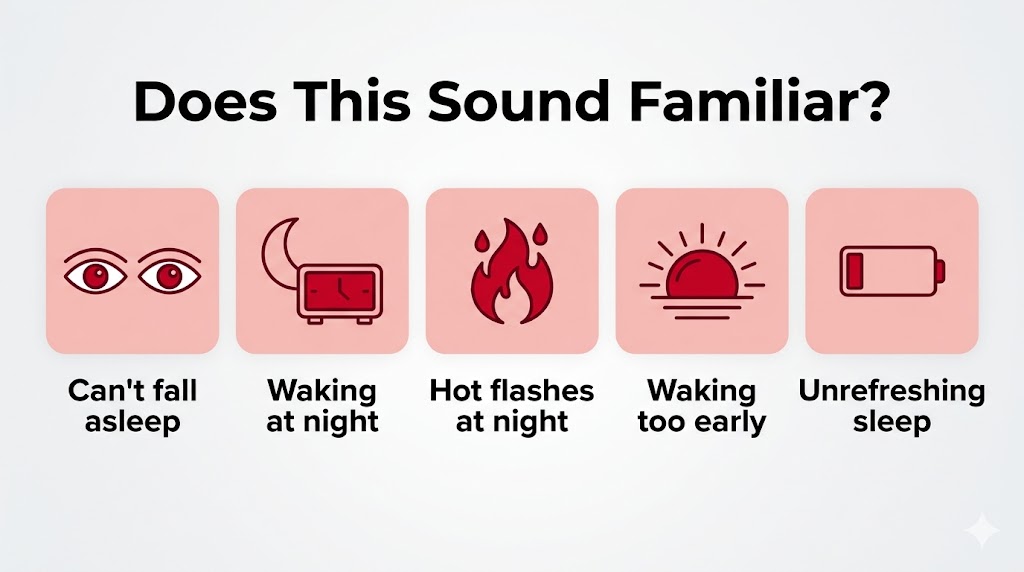
Trouble sleeping in perimenopause doesn’t look the same for every woman. In my practice, I hear all of these:
- Can’t fall asleep: lying awake with a busy, racing mind that won’t switch off
- Waking up at night: especially between 2 am and 4 am, often for no obvious reason
- Hot flashes at night: waking you drenched in sweat, unable to settle back down
- Waking too early and feeling tired but unable to return to sleep
- Light, unrefreshing sleep: spending 7-8 hours in bed but waking up feeling like you barely slept
If any of these sound familiar, you’re experiencing sleep disturbances during menopause that are well-documented, well-understood, and importantly, treatable.
How to Sleep Better During Menopause
There’s no single fix for menopause sleep problems. What works is a layered approach that addresses the hormonal root causes and the behavioral patterns that develop around poor sleep. Here’s how I think about it with my patients.

1. Address the Hormones First
For many women, MHT (menopause hormone therapy) is the most effective intervention for menopause insomnia, especially when sleep disruption is tied to hot flashes and night sweats.
Estrogen therapy reduces vasomotor symptoms, and oral micronized progesterone (bioidentical progesterone) has direct sleep-promoting effects. Some women see dramatic improvements in sleep quality once they begin appropriate hormone therapy.
A systematic review and meta-analysis found that oral micronized progesterone improved total sleep time, reduced time spent awake after sleep onset, and increased slow wave (deep) sleep.
However, MHT isn’t right for everyone, and it requires a thorough individual assessment. But if your provider is dismissing sleep problems without discussing whether hormonal treatment is appropriate for you, it’s worth having that conversation directly.
2. Optimize Your Sleep Hygiene, But Do It the Right Way
“Sleep hygiene” gets thrown around so casually that it’s almost become meaningless. Let me be specific about what actually matters for women going through the menopause transition:
- Keep your bedroom cool: ideally between 65–68°F (18–20°C). Your body needs to lower its core temperature to fall into deep sleep. With estrogen fluctuations disrupting your thermostat, cool air is non-negotiable.
- Consistent wake time: even if you slept terribly. This one habit anchors your circadian rhythm more than almost anything else.
- Limit alcohol: even one glass of wine in the evening can fragment sleep in the second half of the night and worsen night sweats. I know this isn’t what anyone wants to hear. It’s still true.
- Cut off screens and blue light an hour before bed. Blue light suppresses melatonin, and your melatonin production is already declining with age.
- Dim lights after 8 pm to signal your brain that sleep is approaching.
3. Consider a Small Protein Snack Before Bed
This one surprises a lot of women. One cause of middle-of-the-night waking is low blood sugar. During your overnight fast, blood glucose naturally drops. In some women — particularly during perimenopause — it drops low enough to trigger a cortisol spike that wakes them.
A small protein-rich snack before bed (a tablespoon of nut butter, a few bites of leftover protein, a spoonful of Greek yogurt) can prevent this and make a meaningful difference for women who wake consistently between 2 am. and 4 am.
4. CBT-I: The Gold Standard Non-Hormonal Treatment
Cognitive Behavioral Therapy for Insomnia (CBT-I) is the most evidence-based non-drug treatment for chronic insomnia, and it has been specifically studied in perimenopausal and menopausal women with excellent results. Unlike sleeping pills, which mask the problem, CBT-I rewires the thoughts and behaviors that perpetuate insomnia, and the effects last.
CBT-I techniques include sleep restriction therapy (counterintuitive but powerful), stimulus control, and addressing the anxious thought patterns that keep you awake after a hot flash wakes you at midnight. Many women find that CBT-I plus hormonal support is a game-changing combination.
Ask your doctor for a referral, or look for a CBT-I certified therapist or app-based program.

5. Supplements That May Help
Certain supplements can play a supportive role alongside your main treatment approach. The ones with the best evidence for menopause sleep problems include:
- Magnesium glycinate — supports GABA activity and muscle relaxation; many women are deficient and don’t know it
- Melatonin — production declines naturally with age; low doses (0.5 mg–1 mg) taken 1–2 hours before bed can help reset circadian rhythm
- L-theanine — an amino acid from green tea that supports calm without sedation
- Valerian root — some evidence for reducing anxiety-related sleep disturbance
Always discuss supplements with your provider before starting, especially if you’re on other medications.
6. Move Your Body, Especially With Resistance Training
Exercise is a potent and underused sleep aid. A review of 17 studies found that regular exercise significantly reduced insomnia in perimenopausal and menopausal women. Both aerobic exercise and resistance training help, and resistance training has the added benefit of supporting bone density, metabolism, and mood during menopause. Aim for at least 30 minutes most days, but try not to exercise intensely in the two hours before bed.
When to Talk to Your Doctor
Menopause-related sleep disturbances are common, but that doesn’t mean you have to white-knuckle your way through them. Please reach out to your provider if:
- Poor sleep is affecting your mood, memory, work, or relationships
- You suspect sleep apnea (loud snoring, gasping, waking unrefreshed) — estrogen loss increases this risk
- You’re experiencing persistent anxiety, low mood, or hopelessness alongside sleeplessness
- Lifestyle changes alone aren’t making a dent
You deserve more than a shrug and a “that’s just menopause.” Sleep is medicine. Advocate for your rest.
Conclusion
Menopause insomnia is real; it’s hormonal, and it is not something you simply have to endure. Whether it’s night sweats pulling you out of sleep, a racing mind that won’t quiet down, or that frustrating wide-awake-at-3 am pattern — there are reasons it’s happening, and there are evidence-based solutions.
Start with understanding your hormones. Build consistent sleep habits that work with your changing biology. Explore whether MHT is appropriate for you. And know that CBT-I, targeted supplements, exercise, and dietary adjustments all have a role to play in reclaiming your sleep.
Your sleep matters. Your health matters. And you deserve support that treats you as a whole person — not just a symptom to be managed.
Got questions? Drop them in the comments. And please, loop in your friendly OB-GYN. Knowing is half the battle.
Until next time,
Choose happiness. ❤️
Dr. Angela.
Frequently Asked Questions
Why can’t I sleep during perimenopause?
Declining estrogen and progesterone directly disrupt your sleep architecture. Progesterone’s natural calming (GABA-promoting) effects diminish; estrogen no longer steadies your circadian rhythm and body temperature, and cortisol can run higher, making it hard to fall asleep, stay asleep, or get back to sleep after waking.
Is menopause insomnia permanent?
No. For most women, sleep improves once hormones stabilize, either naturally after the menopausal transition or with the help of hormone therapy, CBT-I, or lifestyle changes. The key is not ignoring it and letting chronic sleep deprivation compound into a bigger problem.
Can MHT help me sleep better during menopause?
For many women, yes, especially if insomnia is tied to hot flashes and night sweats. Estrogen reduces vasomotor symptoms that fragment sleep, and oral micronized progesterone has direct sleep-promoting effects. MHT should be discussed with your doctor based on your individual health history.
What is the best natural remedy for menopause insomnia?
There’s no single best remedy. The most effective approach combines good sleep hygiene (especially a cool bedroom and consistent wake time), magnesium glycinate, melatonin if needed, limiting alcohol, regular exercise, and ideally CBT-I for persistent insomnia.
Does magnesium help with menopause sleep problems? Magnesium, particularly in the glycinate form, supports GABA production and muscle relaxation, which can ease the transition to sleep and reduce nighttime restlessness. Many women are low in magnesium without knowing it, and correcting the deficiency can make a noticeable difference.
Can anxiety from menopause cause insomnia? Yes. Hormonal fluctuations during perimenopause affect serotonin and GABA, which regulate both mood and sleep. Many women experience new or worsened anxiety during the transition, and that anxiety, including racing thoughts at bedtime or after a midnight waking, becomes its own driver of insomnia independent of hot flashes.