


I’ve been waiting for this moment for a long time. As someone who has sat across from countless women, women who felt confused, dismissed, misdiagnosed, or flat-out told “you just have cystic ovaries”, I have to say: this one feels like a win.
After more than a decade of global consultation and input from nearly 22,000 patients, doctors, researchers, and advocates from around the world, polycystic ovary syndrome (PCOS) has officially been renamed polyendocrine metabolic ovarian syndrome, or PMOS. The announcement, dropped on May 12, 2026, was published in The Lancet and presented at the European Congress of Endocrinology in Prague.
Now, before you roll your eyes and say, “It’s just a name, Dr. Angela,” stick with me. Because this is not just semantics. This name change has real implications for how you get diagnosed, how you get treated, and how seriously this condition gets taken. Let’s get into it.
So What Was Wrong With “PCOS” in the First Place?
Great question. The term “polycystic ovary syndrome” has been a medical misnomer for decades, and a harmful one at that.
Here’s the problem: the word “polycystic” implies you have pathological cysts on your ovaries. You don’t. What’s actually visible on ultrasound are arrested follicles, not true cysts. The old name suggested something that simply isn’t accurate about the condition.
And that confusion? It cost women years of their lives. According to the WHO, nearly 70% of women with this condition have never been diagnosed — partly because the name itself was sending everyone in the wrong direction.
Think about that. Seven out of ten women with this condition were being diagnosed late, or not at all. The old name also obscured the diverse endocrine and metabolic features of the condition, while contributing to stigma and curtailing research and policy attention. In other words, we weren’t just naming it wrong; we were understanding it wrong. And women were paying the price.
What Does PMOS Actually Mean?
Let’s break it down, word by word, because the new name tells you a lot about what this condition actually is.
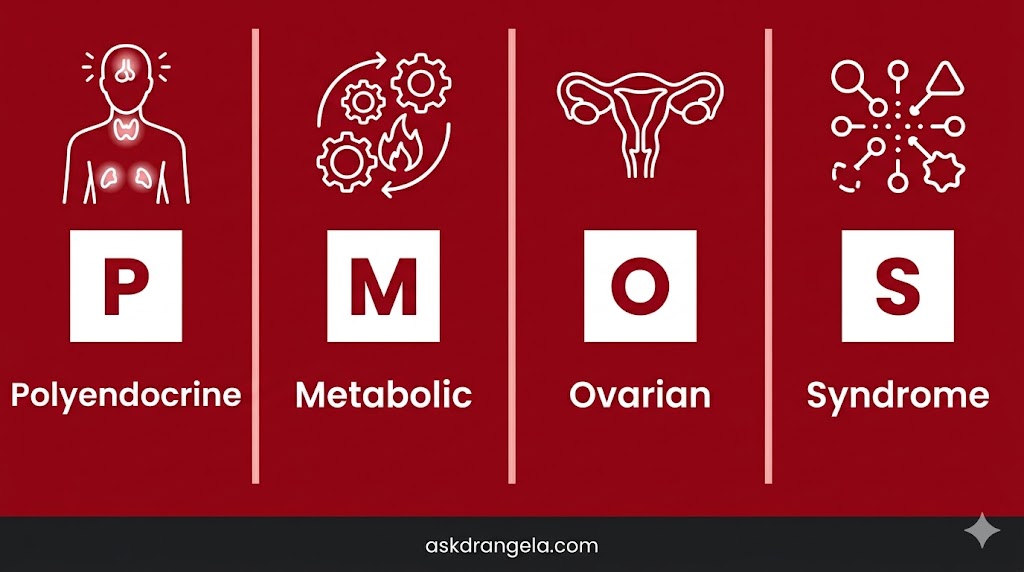
P — Polyendocrine: This recognizes that the condition involves multiple interacting hormonal disturbances, including insulin, androgens, and neuroendocrine hormones. This is not a one-hormone problem. It’s a whole hormonal ecosystem out of balance.
M — Metabolic: This is huge. PMOS is not just a reproductive condition. It has significant metabolic effects, including insulin resistance, weight challenges, and increased risk for type 2 diabetes and cardiovascular disease. In fact, insulin resistance affects an estimated 50–70% of people with PMOS, regardless of body weight.
O — Ovarian: Yes, the ovaries are involved — but they’re not the whole story.
S — Syndrome: A cluster of signs and symptoms that occur together, not one single disease with one single cause.
The new name recognizes that this is not a primarily gynecological disorder, but a complex, multisystem condition involving endocrine, metabolic, reproductive, dermatological, and psychological health. That is a fundamentally different and far more accurate understanding of what millions of women are living with.
What Are the PMOS Symptoms?
Here’s your important reassurance: the condition is the same. Only the name changed. If you were diagnosed with PCOS, you now have PMOS. Your symptoms, your treatment, your labs, all the same conversation, just with better framing going forward.

Common symptoms include:
- Irregular or absent periods
- Excess facial or body hair (hirsutism)
- Acne, especially along the jawline and chin
- Hair thinning or loss on the scalp
- Weight gain or difficulty losing weight
- Difficulty getting pregnant (due to irregular ovulation)
- Skin darkening in body folds (acanthosis nigricans — a sign of insulin resistance)
- Mood changes, anxiety, or depression
- Fatigue
- Sleep disturbances
One thing I want to flag: PMOS looks different in different women. You don’t need every symptom on this list to have it. Some women have mostly metabolic symptoms. Some have primarily reproductive concerns. Some have skin and hair issues with minimal period irregularity.
That variability is exactly why the old name and the old, narrow understanding of the condition were doing women a disservice.
Who Gets PMOS?
PMOS affects more than 170 million people — or one in eight women — worldwide. It is one of the most common hormonal conditions in women of reproductive age. And it is significantly underdiagnosed.
This is especially true for Black women. Research published in the Journal of Clinical Endocrinology & Metabolism found that Black women are significantly more likely than non-Hispanic white women to receive a missed PCOS diagnosis.
Black women with PMOS are also more likely to experience higher rates of insulin resistance, obesity, hirsutism, and cardiovascular disease, and a lower likelihood of getting pregnant, yet are routinely undertreated or dismissed.

Risk factors include:
- Family history (mother, sister, or aunt with PMOS/PCOS)
- Insulin resistance or prediabetes
- Obesity — though many women with PMOS are not overweight
- Chronic low-grade inflammation
I want to say this directly to anyone reading who has been told their symptoms “aren’t that bad” or who spent years being bounced between doctors without a clear answer: you were not imagining it. And the fact that diagnosis was delayed for the majority of women with this condition is a systemic failure, not yours.
How Is PMOS Diagnosed?
The diagnostic criteria haven’t changed with the renaming. Clinicians typically use what’s called the Rotterdam Criteria, which requires at least two of the following three features:
- Irregular or infrequent ovulation (shown by irregular periods)
- Signs of excess androgens — either on labs (elevated testosterone) or clinically (excess hair, acne, hair loss)
- Polycystic-appearing ovaries on ultrasound or elevated anti-Müllerian hormone (AMH) concentrations
Your workup will also likely include bloodwork to assess hormone levels (LH, FSH, testosterone, DHEA-S), thyroid function (to rule out thyroid disease, which can mimic PMOS), insulin and glucose levels, and sometimes a lipid panel.

A note on the transition: if you walk into a doctor’s office and say “I think I have PCOS” your provider will still know exactly what you’re talking about.
The new name will be worked into clinical practice over the next three years, with PMOS formally replacing PCOS in the International Classification of Diseases in 2028. Both terms will be in use during the transition. Don’t let that confuse you; they are the same condition.
How Is PMOS Treated?
Treatment is individualized; What you need depends on what’s driving your symptoms and what your goals are.
Lifestyle
Diet and movement are first-line interventions — not because you need to lose weight, but because both insulin sensitivity and hormonal regulation respond to how you fuel and move your body. A lower-glycemic diet and consistent activity can meaningfully shift the picture. Per ACOG guidelines, lifestyle modification is recommended as the first step for most women.
Hormonal therapy
Combined oral contraceptives are commonly used to regulate periods, reduce androgens, and manage acne and excess hair. They manage symptoms effectively, though they don’t address the underlying metabolic picture.
Insulin-sensitizing medications
Metformin is frequently used in PMOS management to improve insulin sensitivity, support ovulation, and reduce long-term metabolic risk.
For fertility
If getting pregnant is your goal, ovulation induction is the path. Options include letrozole (currently the preferred first-line agent), clomiphene citrate, and in some cases injectable gonadotropins or IVF.
For skin and hair concerns
Spironolactone is an androgen blocker that works well for acne and hirsutism, often used in combination with hormonal contraception.
Mental health support
This one doesn’t get enough airtime. PMOS carries a significantly elevated risk of anxiety and depression, and those aren’t just “side effects of having a chronic condition.” They’re part of the hormonal picture. Please don’t leave mental health off the table when you’re building your treatment plan.
Why the Name Change Matters for Your Care
An estimated 86% of surveyed patients and 71% of healthcare professionals supported adopting a new, biologically accurate name, because the old one was failing them. More accurate naming leads to better research funding, stronger diagnostic frameworks, and — critically — providers who understand they need to look at the whole patient, not just her ovaries.
For patients: this is your permission to demand comprehensive care. PMOS is a multisystem condition. If your provider is only addressing one piece of it, say, your period irregularity, while ignoring your insulin resistance or your mental health, that’s an incomplete treatment plan. You deserve better.
How to Get Help
If you think you have PMOS (or were previously diagnosed with PCOS), here’s how to move forward:
- Start with your OB/GYN or primary care provider. Request a full workup: hormones, metabolic labs, and if indicated, a pelvic ultrasound.
- Ask specifically about the metabolic picture. Don’t let the conversation stop at your periods. Ask about your insulin levels, your cardiovascular risk, whatever applies to your situation.
- Bring your symptoms list. All of them. Don’t minimize. The more complete your picture, the better your provider can help.
- Ask about a referral if needed. Because PMOS is a multisystem condition, you may benefit from seeing an endocrinologist, a reproductive endocrinologist (if pregnancy is the goal), or a dermatologist, in addition to your OB/GYN.
- Find a provider who gets it. Not every clinician is up to speed on PCOS, now PMOS management. If you’re being dismissed or undertreated, especially as a black woman, advocate for yourself — or find someone else.
The Black Women’s Health Imperative has noted this moment as especially significant for Black women, who have long faced dismissal and misdiagnosis with this condition.
Bottom Line

The medical world doesn’t rename conditions lightly. It took 14 years, 56 organizations, and 22,000 voices to make this happen — and the fact that it happened at all says something powerful: your experience matters, your symptoms are real, and this condition deserves to be taken seriously in its full complexity.
If you’ve been dismissed, misdiagnosed, or made to feel like you were overreacting, this name change is, in part, for you.
PMOS is not just a new acronym. It’s a new framework. One that finally sees the whole picture of what so many women have been living with for years. Now the work is making sure your doctor sees it too.
If you have questions or want to share your PMOS story, drop them in the comments below. I’d love to hear from you.
Until next time,
Choose Happiness.
Dr. Angela.
FAQs
Is PCOS and PMOS the same condition? Yes. PMOS is the new, more accurate name for what was previously called PCOS. The condition itself has not changed — only the name and the scientific framing.
Do I need a new diagnosis? No. If you were diagnosed with PCOS, that diagnosis is still valid. It’s always a good time, however, to revisit your treatment plan with your provider.
When will my doctor start using the name PMOS? The transition will take time. Both terms will be used during the planned 3-year transition period, with full implementation in international disease classification systems by 2028.
Does the name change affect my treatment? Not immediately, but the broader understanding of PMOS as a multisystem condition should mean more comprehensive, personalized care going forward.
Is PMOS symptoms more common in Black women? PMOS affects women across all racial and ethnic groups, but Black women face significantly higher rates of missed diagnosis and more severe metabolic complications. This makes early, comprehensive care especially critical.
Resources
- The Lancet — Original renaming publication: https://www.thelancet.com/journals/lancet/article/PIIS0140-6736(26)00717-8/fulltext
- NIH / NICHD — PCOS overview: https://www.nichd.nih.gov/health/topics/pcos
- ACOG — PCOS Patient FAQ: https://www.acog.org/womens-health/faqs/polycystic-ovary-syndrome
- Mayo Clinic — PCOS Diagnosis & Treatment: https://www.mayoclinic.org/diseases-conditions/pcos/diagnosis-treatment/drc-20353443
- Cleveland Clinic — PCOS: https://my.clevelandclinic.org/health/diseases/8316-polycystic-ovary-syndrome-pcos
- Black Women’s Health Imperative — PMOS and Black Women: https://bwhi.org/2026/05/14/pcos-has-a-new-name-why-this-long-awaited-change-matters-for-womens-health/